C&MLibri

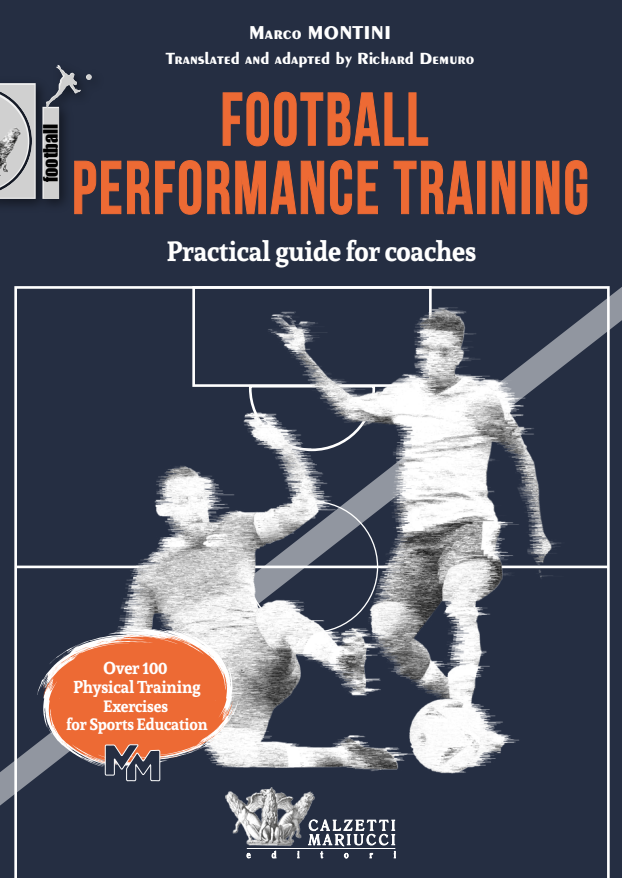

Football performance training. Practical guide for coaches. Ebook
Ebook
 Libro

Guida agli acquisti
Consulta la guida agli acquisti per informazioni su spedizioni, accesso, area riservata e profilo utente, modalità di registrazione… Informazioni per gli acquisti
Football coaching from theory to the pitch by Marco Montini is a football coaching manual dense with essential concepts. It offers a solid pathway for aspiring coaches and is equally valuable as a reference for sports staff who want to review and refresh their knowledge.
From training theory to practice on the pitch
The book starts from the definitions of training and performance, in all their facets and practical connections, and moves on to youth football, coordination abilities, conditioning capacities and the practical activities that develop them.
What you will find in the book
- Strength training, with strength defined as “the muscle’s capacity to generate tension”: a definition as concise as it is important for performance.
- Practical conditioning tools, functional and original in their progressions: high-level work that stays easy to apply.
- Endurance and energy systems, treated with the care that any effective and safe training programme demands.
- Load monitoring and the relationship between external and internal load.
- Player assessment, with test batteries ranging from traditional basic tests to more advanced protocols.
- Injury risk reduction: the factors that influence injury aetiology and management, with practical strategies for a targeted, individualised approach.
Who it is for
Football coaches preparing for their coaching qualifications, fitness and conditioning coaches and technical staff looking for a structured, science-based reference for everyday work on the pitch.
Also available in Italian
The original Italian edition is available in print: Metodologia dell’allenamento nel calcio.
Introduction
Chapter 1 – What is performance training?
- 1.1 Definition and determinants of performance
- 1.2 Invisible training
- 1.3 Motor skills
- 1.4 Principles of training
Chapter 2 – Training in youth sports
- 2.1 Biological age, chronological age and the peak of growth
- 2.2 Sensitive periods
- 2.3 The relative age effect (RAE)
- 2.4 Talent in sport
- 2.5 The coach’s approach
Chapter 3 – Coordination skills & agility
- 3.1 Coordination skills
- 3.2 Free play & street games
- 3.3 Open and closed skill environments and abilities
- 3.4 The determinants of agility
- 3.5 Reaction skills
- 3.6 Everyone on the field!
Chapter 4 – Strength
- 4.1 Choosing the right exercise
- 4.2 General objectives
- 4.3 Core training
- 4.4 Fundamental movements
- 4.5 Strength training methods: exercises and drills
- 4.6 Changes of direction
- 4.7 Functional strength vs traditional – structural strength
- 4.8 Maximum strength, speed-strength, power
- 4.9 Everyone on the field!
Chapter 5 – Endurance & energy systems
- 5.1 Energy systems
- 5.2 Methodology and types of training
- 5.3 The ball as a training tool
- 5.4 Rules and variations for small-sided games (SSGs)
- 5.5 Everyone on the field!
- 5.6 A typical week
Chapter 6 – Training load monitoring
- 6.1 Determinants of physical load
- 6.2 Internal load & external load
- 6.3 Use of GPS data
- 6.4 Considerations and conclusions on monitoring
Chapter 7 – Assessment of the athlete
- 7.1 When to conduct the tests
- 7.2 Anthropometric characteristics
- 7.3 Movement ability – Functional Movement Screen
- 7.4 Metabolic performance
- 7.5 Neuromuscular performance
- 7.6 Assessment of coordinative skills
- 7.7 Data organisation
Chapter 8 – Injury prevention & performance optimisation
- 8.1 Injury statistics, causes & risk factors
- 8.2 Areas of intervention
Conclusions
Acknowledgements
Bibliography
Potrebbe interessarti anche


Calzetti & Mariucci Editori mette a disposizione diverse modalità di accesso ai contenuti video, pensate per rispondere alle esigenze formative di tecnici, operatori dello sport e anche semplici appassionati.
C&Mpartners